Friday, September 4, 2009

Roman Scaphe (Bowl Sundial)

image_65428_v2_m56577569830699708 image_65429_v2_m56577569830699712 Roofed spherical sundial from the 1st or 2nd century AD.

The scaphe is a bowl sundial, designed with a hole to let through a ray of sunlight. The inside is engraved with line and Greek inscriptions. The spot lit by the sunbeam would mark the month, day, and hour. This sundial is created in the shape of a skyphos, or drinking vessel, which is fashionable during the time.

The scaphe was supposed to be positioned vertically with the hole uppermost and the concave bowl facing the observer. The broadest division corresponds to the summer solstice, 24 June, and the narrowest the winter solstice, 25 December.The fan of eleven lines dividing the curving sections marks the length of the twelve daytime hours of the Roman day, which were longer in summer and shorter in winter. The hole in the vessel let through a ray of sunlight that marked the month, day, and hour, moving round the bowl as the position of the sun changed. The opening would originally have been partly closed off with a bronze plaque, restricting the opening and thus focusing the beam more precisely, but this has been lost. The sundial was made for use at a latitude of 41.

Source:

http://www.louvre.fr/llv/oeuvres/detail_notice.jsp;jsessionid=Kh35G2FQJX2VFnXVX7vQd1jHTCLL62MPpyQZXB10CYPXJW5pz3zJ!2029486743?CONTENT%3C%3Ecnt_id=10134198673225839&CURRENT_LLV_NOTICE%3C%3Ecnt_id=10134198673225839&FOLDER%3C%3Efolder_id=9852723696500819&baseIndex=55&bmLocale=en

Tuesday, August 25, 2009

Sunday, August 9, 2009

Star Birth

123107main_image_feature_371_ys_4Artist's Conception of L1014 (NASA/JPL-Caltech/R. Hurt (SSC))

“In this artist's conception, we peer through the dark dust of L1014 to witness the birth of a star. NASA's Spitzer Space Telescope has detected a faint, warm object inside the apparently starless core of a small, dense molecular cloud. If, as astronomers suspect, there is a young star deep inside the dusty core, it would have a structure similar to this illustration.
Dark dust from the cloud, attracted by the gravity of the newborn star, forms a disc as it spirals inward. Often, the hidden birth of a star is heralded by bipolar outflows, jets of material moving outward from the star's poles. Although astronomers do see a faint "fan-shaped nebulosity" where they might expect the jet to be, the existence of the jet has yet to be confirmed.”

L1014 is a very young star located in Cygnus. It is the smallest star of this age discovered so far. It is hidden within a dark nebula in which no stars have been suspected. If it won't grow much more it will become a brown dwarf.

Source:

http://sscws1.ipac.caltech.edu/Imagegallery/image.php?image_name=ssc2004-20b

http://jumk.de/astronomie/special-stars/l1014.shtml

Sunday, July 12, 2009

Pink Floyd’ Astronomy Domine


PinkFloyd-album-piperatthegatesofdawn_300

Cover of The Piper at the Gates of Dawn (1967)

"Astronomy Domine" is a song by British psychedelic rock band Pink Floyd. It is written by Syd Barrett (the original vocalist/guitarist) and was the first track on their album, The Piper at the Gates of Dawn (1967). The lead vocal was sung by Barrett and keyboard player Richard Wright.

The song opens with the voice of their manager at the time Peter Jenner, reading the names of stars through a megaphone. The intention of this opening is to replicate the feeling of outer space, with Jenner's voice sounding like an astronaut's over an intercom. Barrett's Fender Esquire then seemingly emerges from the distance and grows louder. At 0:19 a rapid beeping sound appears, again reaffirming the feeling of distant space. At 0:26, Mason's distinctive drum fills emerge, followed closely by Barrett's bluesy, sinister-sounding guitar (perhaps reminiscent of Duane Eddy) in a figure suggestive of the brass motif from "Mars, the Bringer of War" in Holst's The Planets. Wright's Farfisa organ is mixed into the background. Barrett's incantatory lyrics about space again support the cosmonautical theme in the song, mentioning planets Jupiter, Saturn, and Neptune as well as Uranian moons Oberon, Miranda, and Titania, and Saturn's moon Titan. Barrett and Richard Wright provide lead vocals. Waters' repetitive bass line, Wright's Farfisa organ, and Barrett's kinetic slide guitar then dominate, followed by the voice of Peter Jenner again through a megaphone.

The song has an unusual chord progression: E, E-flat, G, A. The sound of this chord progression, in conjunction with the use of a Binson echo machine for the guitar, has a very distinctive psychedelic character. The track is the album's most "space rock" song, alongside the longer "Interstellar Overdrive". The style of the song and its use of sound effects would influence the future work of Pink Floyd, and its influence can be felt on Ummagumma (1969) and even The Dark Side of the Moon (1973).


Source:

http://en.wikipedia.org/wiki/Astronomy_Domine

Friday, July 3, 2009

Planisphaerium Bianchini – The Greco-Egyptian Constellation


index

Planisphaerium/Tabula Bianchini or the Planisphere astrologique de style Egyptian (From Origine de tous les cultes, ou religion universelle, par Dupuis. (Paris E. Babeuf 1822) Dupuis (1742-1809), Author.)


This drawing is a graphical depiction of an astrological dicing board made of marble, which involved divination by throwing a dice on top of it. It is probably from the 3rd century AD. It was found on the Aventine Hill, Rome, and now was kept in Louvre, Paris.

The center of the system is drawn on the pole of the ecliptic (which is exactly alpha Draconis), and not on the pole of the equator (Ursa Major), because the Sun’ passage through the sky along the ecliptic is the relevant path for astrology. Because of this, three polar constellations are depicted in an interesting manner: Ursa Major and Ursa Minor, with Draco coiling between them.

The first band from the center depicts the animal of the Dodecahoros Chaldaike, a Chaldean zodiac. It was incomplete, but based on another finding from Egypt (see below), it can be listed that the constellations are: a sitting cat (Aries), a dog or a jackal (Taurus), a serpent (Gemini), a scarabeus or a crab (Cancer), a donkey (Leo), a walking lion (Virgo), a goat or gazelle (Libra), a bull (Scorpio), a falcon (Sagittarius), a baboon/ape (Capricorn), an ibis (Aquarius), and a crocodile (Pisces)
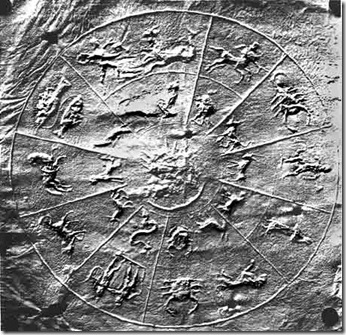
dodekaoros_1

The complete marble slab of the Dodecahoros, sighted in Cairo antique shop in 1901.


The next two outer band depicts the standard Greek zodiac.

The last band shows the Egyptian decans, the Greco-Egyptian names of each one is inscribed below each figure. Just outside this band are depiction of faces of the 7 planetary gods that is associated with the decans. We can see that a woman holding a mirror is definitely Venus, and the one with a winged hair is Mercury. Based on this, I can - more or less - list the name of each decans and the associated god:

Aries
  • Asiccan, Mars
  • Senacher, Sun
  • Acentacer, Venus
  • Taurus
  • Asicath, Mercury
  • Viroaso, Moon
  • Aharph, Saturn
  • Gemini
  • Thesogar, Jupiter
  • Verasua, Mars
  • Thepisatosoa, Sun
  • Cancer
  • Sothis, Venus
  • Sith, Mercury
  • Thuimis, Moon
  • Leo
  • Aphruimis, Saturn
  • Sithacer, Jupiter
  • Phuonisi, Mars
  • Virgo
  • Thumis, Sun
  • Thopithus, Venus
  • Aphuth, Mercury
  • Libra
  • Semeuth, Moon
  • Aterechinis, Saturn
  • Arpien, Jupiter
  • Scorpio
  • Senthacer, Mars
  • Thepiseuth, Sun
  • Sencmer, Venus
  • Sagittarius
  • Eregbuo, Mercury
  • Sagen, Moon
  • Chenen, Saturn
  • Capricorn
  • Themeso, Jupiter
  • Epima, Mars
  • Homoth, Sun
  • Aquarius
  • Oroasoer, Venus
  • Astiro, Mercury
  • Thepisathras, Moon
  • Pisces
  • Archathapias, Saturn
  • Thopibui, Jupiter
  • Athembui, Mars
  • It’s a pity that I cannot find a complete list of these figures that represent the decans.

    And the lastly, on the four corners are winged heads representing the four main winds, only one is depicted here.


    Source:

    http://members.optusnet.com.au/gtosiris/page11-14.html

    http://digitalgallery.nypl.org