
A sundial commemorating the quatercentenary of Olomouc University (1573–1973) on the facade of the Faculty of Philosophy
Showing posts with label Sundial. Show all posts
Showing posts with label Sundial. Show all posts
Monday, September 13, 2010


Friday, September 4, 2009
Roman Scaphe (Bowl Sundial)


The scaphe is a bowl sundial, designed with a hole to let through a ray of sunlight. The inside is engraved with line and Greek inscriptions. The spot lit by the sunbeam would mark the month, day, and hour. This sundial is created in the shape of a skyphos, or drinking vessel, which is fashionable during the time.
The scaphe was supposed to be positioned vertically with the hole uppermost and the concave bowl facing the observer. The broadest division corresponds to the summer solstice, 24 June, and the narrowest the winter solstice, 25 December.The fan of eleven lines dividing the curving sections marks the length of the twelve daytime hours of the Roman day, which were longer in summer and shorter in winter. The hole in the vessel let through a ray of sunlight that marked the month, day, and hour, moving round the bowl as the position of the sun changed. The opening would originally have been partly closed off with a bronze plaque, restricting the opening and thus focusing the beam more precisely, but this has been lost. The sundial was made for use at a latitude of 41.
Source:
Wednesday, June 25, 2008
Sundial of Prinsentuin, Groningen

Sundial of the Prinsentuin (Groningen, The Netherlands) etched just above the entrance to the garden. Nothing really symbolically interesting in the sundial apart that the sun has a “nose” that acts as a shadow-catcher. And some fancy Latin and Dutch words. I should admit that I didn’t really put enough effort on researching this particular sundial. Its a beautiful sundial though.

The garden itself is also interesting. It is one of the purest examples of a Renaissance garden in Netherlands, with its rose garden (I don’t even recognize roses until I saw the photo in my computer) and herbs garden. Some of the hedges also forms a 'W' and 'A' (for the first letter of Willem Frederik of Nassau and his wife Albertine Agnes of Nassay (the stadholder of Groningen) (see pictures below). Cool and charming little garden anyway.
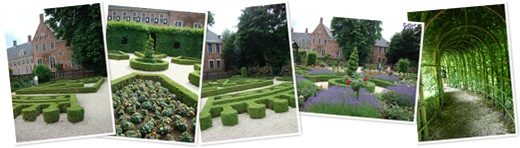
PS: my first attempt to use MSN Photo Album. Cute, but I need some copyrighting features.
Subscribe to:
Posts (Atom)

