Showing posts with label Vulcan. Show all posts

Saturday, March 28, 2009

Järventaus’s Solar System of the Steamopera

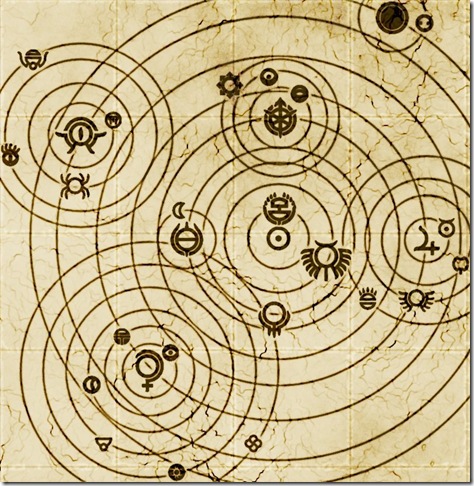
astromap2-fullSolar System of the Steamopera

A very inspiring art by Naeddyr or Järventaus (?) about a solar system in his parallel universe, The Steamopera. It is something like a space age, but in a 19th-century universe.

What inspires me is, of course, the visualization of the solar system (especially the inner bodies). Interestingly, he includes all the real inner planets of the solar system plus some real historical hypothetical planet.

Glyph of Vulcan

Firstly is the appearance of Vulcan below Mercury’s orbit, or in his Steamopera’s term, Vulcanus. The symbol is probably derived from anvil or some sort with a fiery background. Vulcan is actually the 19th century creation of Le Verrier, hypothesized as a planet which orbits closer to the Sun than Mercury is, and perturbs Mercury’s orbit. Later, Vulcan is thought to be the parent body of the Vulcanoids, another asteroid belt which is rich in iron and nickel, and has similar albedo to Mercury. The bodies have never been observed and is likely non-existent, although some scientist still peers through this area looking for possibilities. 
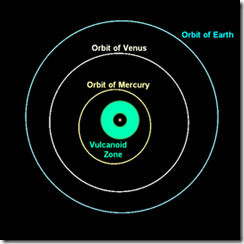
270px-Vulcanoidorbits Orbits of the Vulcanoid (Wikipedia)

Secondly is the appearance of Nemesis as the alien exoplanet which orbits too close to the sun and destroyed by its gravity to form later, the “Nemesis-tail” (sort of the secondary Main Asteroid Belt). This event creates a period of “Rage” on Earth (Tellus) around the 18th century, where series of meteoric bombardments and volcano activities happens and destroys some of the great civilization. Interestingly he includes the “Asteroid Field” as well with a description “not very interesting”. Well I say it’s a pity since the 19th century concept of the Main Asteroid Belt is actually very rich in symbolism it self: it was previously thought as an area where four planets orbit the sun: Ceres, Pallas, Vesta, and Juno ... so.
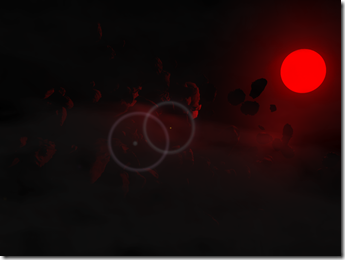
800px-Nemesis Nemesis on the right, and perturbed Oort Cloud (Wikipedia)

Nemesis is actually a 1980s creation of a team of scientists who tries to explain an extraterrestrial origin for the mass extinction that was concluded to be periodically happens every 26 million years. It was hypothesized that this object, which later called Nemesis, was the cause for the mass extinction. Nemesis is hypothesized as either a red dwarf or brown dwarf star which is too dim and too far to be seen. Nemesis orbits the sun in a very eccentric orbit between 50,000 to 100,000 AU. On some point when it is closest to the sun, it perturbs the Oort Clouds, sending millions of falling comets to the inner solar system every 26 million years. Too bad today we know that most comets are from the KBO, which orbits 30 – 55 AU, closer to the sun than previously expected. But still, an interesting theory to be thought about.


Jarventaus’s glyph of Io (the cow), Europa (the labrys of the Minoan civilization), Ganymede (Eagle!), Callisto (bear’s paw)

Thirdly is the glyphs for the Galileans (I don’t know if this term exist in his parallel universe). For some unknown reason, I love how the glyph for Io turns out (simple and memorable). Ganymede is clearly from the eagle-related myth of Jupiter and Ganymede. Europa, now I know what is that. The labrys, a symbol that is closely associated with Minoan civilization. 

Io Europa Ganymede Callisto

Moskowitz’s Glyph of Io (Iota), Europa (Epsilon), Ganymede (Gamma), Callisto (Kappa)

Denis Moskowitz also creates a rather scientific glyph for the moons (including the other moon’s glyph). Far more scientific, simple, and memorable, but not as pleasant-looking as the Steamopera’s moon glyph.

Fourthly (lol I like using -ly for the 19th century feelings :P), is the very intimidating moons of the Icy Giants of Minerva. I don’t know why but Minerva sounds like an appropriate name to replace Uranus, but the moon Pallas, Arachne, Nike, and Medusa is all a very weird moon with a very intimidating symbol (as well as Minerva itself). These whole system seems to be a system of angry goddesses.
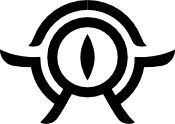
symb-minerva

Glyph of Minerva and its moons, Pallas (the helmet-like one), Arachne (spider legs), Nike (trophy, wings? I don’t know?), and Medusa (obviously snake hair and an eye). But why Pallas and Minerva, same person name?

The last planet of the Solar System is Nox, an icy cold gas giant with its moon Thanatos, a gigantic rocky planet about three times the size of the Earth. Talk about potential for developing a story here.

symb-nox symb-thanatos

Glyph of Nox and Thanatos, I have nothing to say

Too bad he seems to stop the blog-creation some where in 2007, no improvements. But I think he’s going to create some more stories for his parallel universe. I’m probably going to repost the glyphs in the future because I love symbolism.

Link:

Deviantart: http://naeddyr.deviantart.com

The Steamopera: http://naeddyr.googlepages.com/home

Denis Moskowitz Site: http://www.suberic.net/~dmm/graphics/astro/moons.html

Copyright all belongs to Kristian Järventaus, all him, HIM! FOR ETERNITY! Bwahahahaha! Glory to the Banana Kittehs!

Friday, February 6, 2009

The Zodiac of Jacob de Wit Room

DSC07055Jacob de Wit Room, Bijbels Museum, Amsterdam  

This was the original reception hall of the Cromhout houses in Amsterdam. The ceiling in particular is the part of the room that interest me, the fact that they includes a well thought zodiac rulership. The ceiling is painted by Jacob de Wit in 1718. It is made up of ten canvases crowded with a variety Roman gods and the 12 zodiac signs in a setting of carved oak beams. Jacob de Wit is known to paint very fast, able to complete a painting in a mere two hours.

  The gods with all the might and the least of the clothes they could afford. Jupiter in the center with, well … the zodiac, and if you see it closely, four personification of the seasons: two o’clock position: Ceres as the summer (you can see her sickle there), Proserpina is above her (holding ears of wheat); ten o’clock Bacchus as the autumn (a bit of a party there, he’s with his companions); seven o’clock is I don’t know who that is, represents the winter, probably Father Winter or Vulcan; and on four o’clock Flora as the spring (why oh why is she in Libra . . .).

Other frames on the ceiling represent each of the sign of the zodiac with a certain symbolic rulership for each of the signs.

Aries
The central figure is Jason, and the hanged sheep is the golden fleece as Aries, supposedly hanged on an oak tree (or a dead oak tree in this case) around a sacred grove. Beneath the sheep is the sleepless monster (like me). Once you see the color of the cloud is getting darker, it means that the god is basically very low in the sky and very close to you, so the angle is kind of awkward.

Anyway, I prefer Mars to be in the scene, but Jason is also great, what power Aries is that red robe and the armor, so it is okay.
Taurus 
Venus and Cupid (or Amor) playing along with Taurus, very high above the sky (I have to zoom in my camera into this small spot in the painting). Taurus is supposedly the image of Zeus as the white bull who abduct Europa to Crete, so there’s a love thing going on there.
Gemini
Gemini depicted as two putti, the blonde one with clothes is probably Pollux, the immortal one, while the other “unadorned” one is the mortal Castor; or they are probably just a mere putto dudes.

Flora is above them carrying a basket of flower. Supposedly she represents spring, so I think she’s actually belongs to the previous Taurus depiction, although she is way too far from Venus and Cupid.

Below them is Iris, goddess of rainbow, female version of Mercury, very suitable for the Gemini canvas.
Cancer
Continue down the rainbow, and very close to me (notice the dark cloud again) is Juno, naturally with peacocks hanging around. Below her is Cancer as the yummy lobster. I think Cancer is the worst depicted signs of all. It was often depicted not as a crab but as something else, either as lobsters or a monster (obviously in those days, people never saw a crab). This depiction of Cancer is interesting, because it is red, which means it is well-cooked and ready to be eaten lol.

Cancer is supposedly the giant crab which was sent by Hera to agitate Heracles while he was fighting Hydra, but while the crab clung onto his toe (giant crab clinging on Heracles’ toe???), it was stomped and crushed. Later, Hera commemorates her crab as Cancer. Very weird indeed.
Leo
Hercules holding his signature club together with Leo the lion, way above the heaven. The lion is probably a mere symbol of Hercules’ courage or probably represents the Nemean Lion(?). If it does represents the Nemean Lion, I guess they stop fighting in the end.
Virgo
One of the nicest painting I think. The central figure holding a sickle is Ceres. Proserpina is the one holding ears of wheat. The figure crowning Ceres must be Virgo.

Since some representation of Virgo is a maiden holding ears of wheat and (sometimes) winged. I think Proserpina could well be representation of Virgo, since she’s not only holds ears of wheat, but also seems to have a wing (her billowing robe).
Libra
Bacchus and the satyrs, drinking . . . below age Libra tried to join them. Bacchus is often personified the season of autumn, so October (Libra) and autumn is a good match.
Scorpio
Vulcan is the center figure, and Scorpio is there, trying to scare a person, probably Orion? Why do Vulcan have to be the central figure of Scorpio? He might be the personification of winter . 

Coincidentally, the “volcano” of Vulcan also represents the destruction power of Scorpio in astrology.
Sagittarius
Nessus kidnapping Deianira, Hercules’ mistress. The ancient time is full of rapists, I think women actually enjoy being kidnapped back then lol.

Sagittarius is ruled by Jupiter, who is an amorous god, probably that’s how you interpret this painting. Astrology is full of suggestion. The same kind of suggestion influence people these days with the “modern astrology”; it plays with your mind.
Capricorn
The central figure is Vesta, accompanied by the Vestal Virgins and the organized Capricorn goat. One of my favorite painting in the bunch (my photo doesn’t represent the awesomeness of Vesta’s cloth texture).
Aquarius
Janus showing his young face (you can see the brow of his second old face just behind his head). He is also depicted holding the ouroboros, symbol of continuity. Aquarius is the guy with the urn. He could be Ganymede, or just plain personification of Aquarius.
Pisces
Oceanus and the representation of Pisces, a fished fishes! Awesome as in there are two fishes, but instead of connected with a cord by their tails, the fishes are depicted here connected with a cord by their mouth! and fished! Poor Pisces.