Tuesday, April 21, 2009

Gliese 581 System

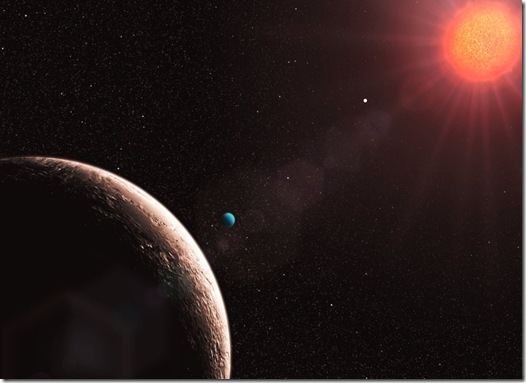
phot-15a-09-fullres Planet E of the Gliese 581 system (foreground), the smallest planet to be discovered. The blue planet is the giant gas planet Planet D, probably have ocean in it. Small dot in the center is Planet C. White dot close to the star is Planet B (http://www.eso.org)

Today April 21, 2009, astronomers announce the discovery of Gliese 581 e, the smallest exoplanet ever found. I will use this occasion to find out more about the system.

The sun of the system is of course the star Gliese 581. The star is a red dwarf star located 20.3 light years away from Earth (a relatively close distance). It is pretty much the sun after the red giant phase, a dying and shrinking star. This sun is dim and small, only 0.013 times the brightness of our sun, and only 0.29 times the radius of our sun. This kind of star probably produces little stellar wind that planets can orbit closer and has satellites around it without being disturbed by the stellar wind.

Gliese 581 System The orbits of planets of the Gliese 581 system. All the orbits depicted here is closer than Mercury’s distance to the sun (http://www.eso.org)

Compared to our solar system, the planets of the Gliese 581 System orbit far closer to the star than that of our own system. All of the planets in this system orbits closer to its sun than Mercury’s distance to the sun. Since the star Gliese 581 is small, planets are logically orbits closer than the planets in our solar system.

Gliese 581 Habitable Zone Comparison between the habitable zone of our Solar System and the Gliese 581 System (Based on a diagram by Franck Selsis, Univ. of Bordeaux.)

The planets of the Gliese 581 system is relatively bulky and large compared to the planets of our solar system. They also strangely orbits closer to one another. I have the feeling that this may have been due to uncertainties and I think that it is possible for the planet to be actually 50% smaller than its initial assumption. These planet may be tidally locked the star, and is supposed to be perturbing each other, although it seems that this is not the case.

So here are the current members of Gliese 581:

776px-RedDwarfNASAGliese 581


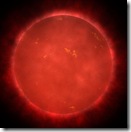
Third the size of our sun, and 50 times colder. This sun radiates primarily near infrared, so everything around would appears uncomfortably red.

Untitled“Planet E”


Distance 0.03AU, complete its orbit after 3 days, 1.9 earth-masses.

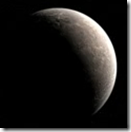
The innermost planet of the system, and also the smallest exoplanet to be found. It is has a similar distance with the distance of Io to Jupiter. This planet is probably lack of atmosphere due to its high temperature, small size, and strong radiation from the star.

phot-22a-07
”Planet B”

Distance 0.041AU, complete its orbit after 5.3 days, 16 times earth-masses.

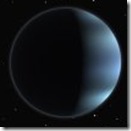
Neptune sized planet. Largest planet in the system, probably a hot gas giant. It has a similar distance with the distance of Europa to Jupiter (imagine Jupiter 2 times as big orbited by the planet Neptune). This planet is big enough to cause the star Gliese 5811 to wobble.

C  “Planet C”

Distance 0.073AU, complete its orbit after 13 days, 5 times earth-masses.

First low mass exoplanet found to be near its star’ habitable zone. Since the region of Planet C’s orbit is comparable to the area where Venus orbits our sun, it is now thought that this planet may experience a runaway greenhouse effect like Venus does, and so is probably not habitable.

asdasd“Planet D”


Distance 0.22 AU, complete its orbit after 67 days, 7 times earth-masses.

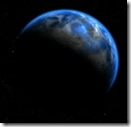
The planet furthest out in the Gliese 581 system so far. It is probably too massive to be made only of rocky material, but astronomers speculate that it is an icy planet that has migrated closer to the star. Planet D was previously thought to be too cold for life to exist, but further studies released in April 2009 confirmed that this planet lies within the habitable zone and large deep ocean may exist. 

I think it would be nice if a name is assigned for each of the planet :)

Sunday, April 12, 2009

Leo and Water

water jars and standWater jars and stand from the Byzantine Period (8th-13th century BC)
© R.M.N./B. Hatala

These porous jars are used in the 12th century AD by the Coptics to keep water cool by using evaporation. Excess water seeped through the ceramic, then flowed from the cavities into a pipe that emerged through the lion's mouth carved at the front of the stand. The water that dripped from the lion’s mouth was then collected in a container.

Why do lion spurts water from its mouth? The lion has always been associated with water in the Mediterranean world; even today, fountain water still spurts from lions' mouth. In Egypt, this could be explained by the fact that the Nile flood occurs when the sun is in Leo. Pliny wrote that the Egyptians also worshipped the stars of Leo because the rise of the Nile happens when the sun moves to Leo (actually it is also explained that the inundation of the Nile is caused by the setting of Aquarius into the Nile, pouring his water into the Nile and thus causing it to flood).

Another explanation is that the Sun was in Leo during Midsummer, and during this time the lions of the Egyptian desert went to banks of the Nile where they could find relief from the heat in the flooded water of the Nile.

NileMosaicOfPalestrina Nile Mosaic of Palestrina depicting the scene around the Nile, including the lion and some monsters (ca. 100 BC). Wikipedia 

Another explanation is the symbolism of lion in the Roman world, in which the lion symbolizes the cleansing fire; the water that poured through the lion’s mouth was therefore pure and fit for either drinking or religious purposes.

Link:

http://www.louvre.fr/llv/oeuvres/detail_notice.jsp;jsessionid=JvX87QnLs1H3TGRhdv6GJ2kqJ2GwKTTXMLYWSPLGqnzXTgRLGmSN!-537807899?CONTENT%3C%3Ecnt_id=10134198673225210&CURRENT_LLV_NOTICE%3C%3Ecnt_id=10134198673225210&FOLDER%3C%3Efolder_id=9852723696500810&baseIndex=1&bmLocale=en

Friday, April 10, 2009

Atmostheory - Retro Solar System Poster

01Atmostheory, The Solar System

ATMOSTHEORY is the one-man design studio of Christopher David Ryan, based in Portland, Maine. Cute and simple Pop art but also retro-looking, with almost a monochrome quality. He’s not particularly focused in astronomy, but I like the creativity :D.

cdr-solar_system

Source:

http://atmostheory.com/projects/the_solar_system/

Tuesday, April 7, 2009

So it will be Vanth

Vanth

S/1 (90482) (2005) Vanth

Discovered 13 Nov 2005 by M.E. Brown and T.-A Suer.

Vanth is a daimon in Etruscan mythology who guides the dead to the underworld. She often appears on tomb paintings and sarcophagi where she is depicted with wings and a torch, and she is frequently shown in the presence of Charun, a guard of the underworld. Name suggested by Sonya Taaffe.


I have to say I really like it … it suits extremely well, and it is the number one proposed name for the new moon and also suggested by me in 1 90482 (2005) Needs a Name. But well of course, some of us are still waiting for a large celestial body to be named after Persephone (whether it is Proserpina, Phersipnai, Prosperina). Well until then we are still waiting for Pluto’s wife to make her appearance.

There are thousands of suggestion for the Orcus’s Moon, and out of those suggestions, Vanth is chosen. And so I say let us commemorates some of the good and silly names suggested for the new moon of Orcus.

The Good Names

411px-Milano_-_Vetrata_ottocentesca_del_Museo_Poldi_Pezzoli_-_Caronte_-_Foto_Giovanni_Dall%27Orto_-_14-sept-2003790px-Herakles_Kerberos_Eurystheus_Louvre_E701 

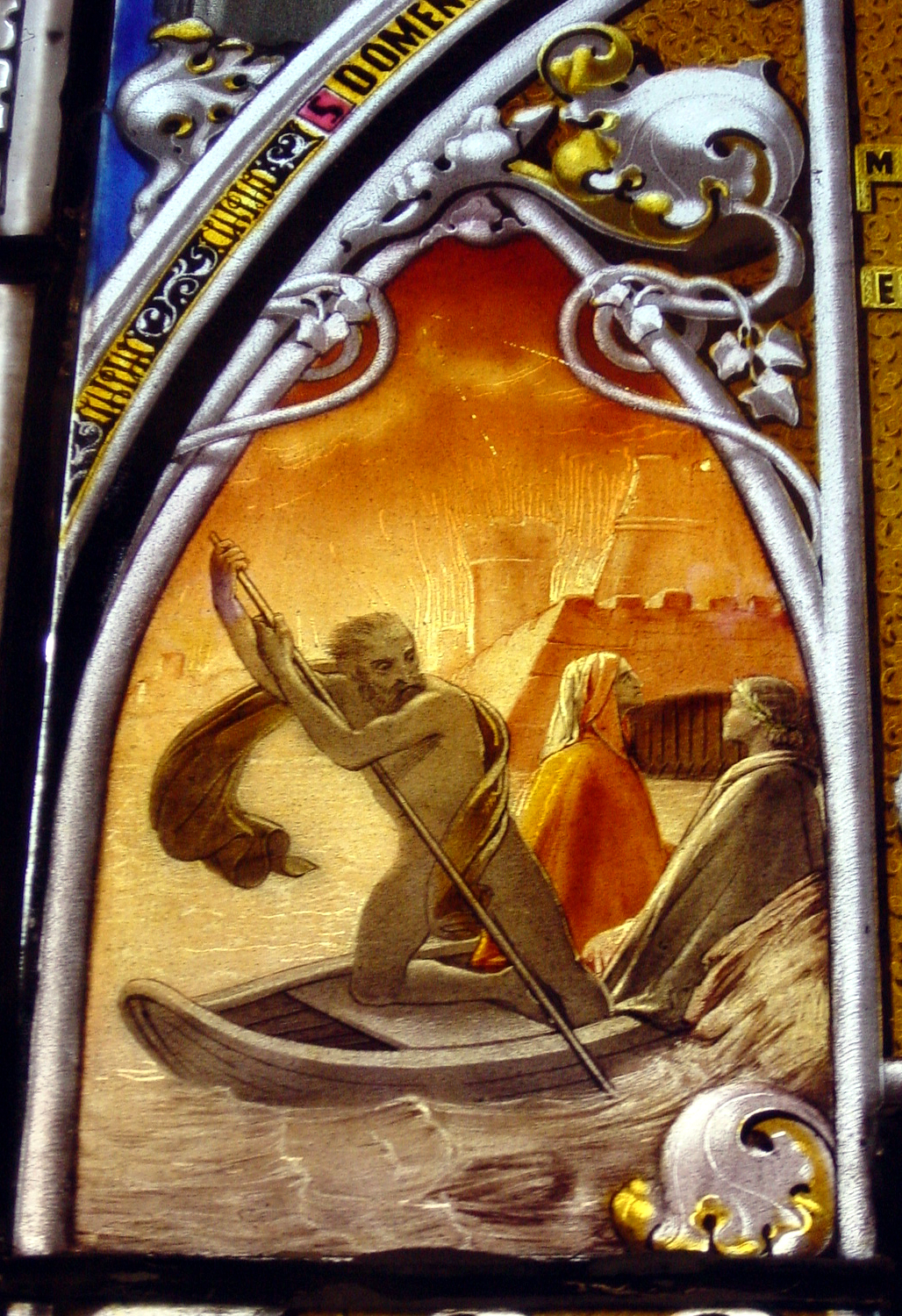
(left) Phlegyas riding his boat with Dante and Virgil. (right) Cerberus in an Etruscan vase. For other gods picture see my previous blog 1 90482 (2005) Needs a Name

  • Vanth (winner!)
  • Phlegyas (equivalent of Charon, ferrying souls across the Styx)
  • Proserpina (wife of Orcus (I believe this is the correct spelling of what Mike Brown refers to))
  • Cerberus (“Orcus’ warder” (Virgil))
  • Charun (demonic counterpart of Charon)

The Silly Names

shamuStephen Colbert shrek-2-fiona-x mork&mindy

(left to right) Shamu the Orca, comedian Stephen Colbert, Princess Fiona, Mork & Mindy

  • Shamu (The Orca) 
  • Colbert (Stephen Colbert)
  • Mindy (counterpart to Robin Williams’ Mork, who was from Ork)
  • Fiona (Princess of Fiona, bride of Shrek, the ogre)
  • Norahc (Charon read backward)
  • Otulp (Pluto read backward)
  • Orcus Porcus (???)
  • J.R.R. Tolkien related names
  • Dungeons and Dragons related names
  • Disney-related names

So in the end I’m glad the name was not Shamu, I mean, putting an orca into a dark cold barren KBO region?

Dava Sobel’s The Planet and Lynette Rene Cook Artwork

10221895 The Planets, by Dava Sobel © 1997-2009 Barnesandnoble.com llc

Dava Sobel, the best-selling author of “Longitude” and “Galileo's Daughter”, write her newest book in 2005, The Planet. Well I’m not a good reader myself, but her knowledge on the subject and the way Lynette Rene Cook, the illustrator for the book, applies her art in the book is very rich in symbolism, which makes the book interesting. In this book, Dava Sobel explores the origins and oddities of the planets through the les of popular culture, astrology, myth, science fiction, art, music, poetry, biography, and history. Her graceful way of telling the story makes the book one of important collectables for those who are interested in astronomy.

Well, here are all the 12 arts from the book.

sobelmodelworlds Model worlds: (overview)

How Dava Sobel became a person of astronomy, of her childhood. There’s a diorama of the Solar System in a shoe box supposedly made by Dava Sobel during her childhood, of course a simpler solar system of the 1950s with fewer celestial body. On the wall are the numerous celestial bodies of the Solar System as people know today.

sobelsun

Genesis: (the sun)

Sort of Bosch’ surrealistic Garden of Eden of the planets. There’s a sundial with the sun photosphere, a solar eclipse. A hedge with the Earth’s continent of Pangaea. The sundial has the Sun’s photosphere on the surface. Solar eclipse in the sky, Animals on the roots of the central tree, weird shaped plants around, as if it was not fully developed in the Eden.

sobelmercury

Mythology: (Mercury)

The Mercury chapter is about mythology because there is more mention of Hermes (Mercury) in myth than any other gods in the Greek pantheon. The feather probably symbolizes the fleet-footed Hermes, or the fact that his sandals have wings attached to it. On the background is the world of the dead and the world of the living (notice the tree on the foreground which is dead on the left side and alive on the right side)

sobelvenus

Beauty: (Venus)

Temple of Venus? the fact that the Mayan has their own calendrical system based on Venus. Different phases of Venus, and the brightness of Venus compared to the Moon.

Another different world on the bottom, Venus surface based on Magellan’s  radar image, the Magellan spacecraft, and the goddess Venus with her flower the rose. Also I notice a small photograph of Venera USSR’s Probe, which is the only photos of Venus’ surface.

sobelearth

Geography: (Earth)

On the wallpaper, the Copernican system of the universe (solar system), the perception of Earth as a flat body, Columbus’ ships, the Earth’s interior, everything related to the concept of Earth

sobelmoon

Lunacy: (the moon)

Very much an astrology-influenced pictures, I should say that I don’t really like when this kind of subject started to appear, because sounds very much like a the mambo jumbo world of the Wiccan community or the astrologers. Nevertheless in the image is the lunar Apollo Modules on the gazebo, white flowers (sort of related with the night garden), the Luna moth, and of course water.

sobelmars

Sci-Fi: (Mars)

Mars surface blasting into space and drifting toward Earth, falling as a meteoroid, one of the famous Martian meteoroids is the one found in the poles, depicting bacteria-like features on the surface. UFOs, the fact that Mars is the most popular planet for us, and small balls of the watery Mars and the Mars as it was depicted by Percival Lowell, showing “canals”.

sobeljupiter

Astrology: (Jupiter)

I must say that Jupiter looks very beautiful with the horoscope. The horoscope is the real natal chart for Galileo spacecraft (okay, I don’t like this). There is also the Galileo spacecraft, the four Galilean moons, and a comet. I personally think that Lynette Cook should shows the Shoemaker-Levy instead of other comet.

The fact is astrology is depicted here is also because Jupiter system is one of the discovery which led to the break up between astronomy and astrology.

sobelsaturn

Music of the spheres: (Saturn)

My favorite image for the book. It depicts Saturn as it is seen by Cassini, the Huygens space probe falling into Titan’s cloud-covered surface. On the wallpaper is the actual score from Holst’ Saturn movement (reputedly to be Holst’ favorite piece from The Planets Suite. There is also some heavenly tone created during the Renaissance and also a pattern of Cassini Spacecraft and the Huygens Probe on the tiles.

sobelurnept

Night air: (Uranus and Neptune)

The image depicts the 7-foot telescope that Herschel used in his back yard garden. There are three Uranus in the illustration. A shattered photo frame of a comet, because Uranus was thought as a planet before; and also the Voyager image of the bleak, rather boring Uranus in the other frame.

sobelpluto

UFO: (Pluto)

Ellis Island in the background, an association of Pluto with an alien, a foreigner, probably also a question of identity (I like this). Water flowing in from the window, symbolizes the overflowing knowledge of some other things yet to be found later (Sedna, Orcus, Varuna, Eris, etc.). The window is the window of the Lowell observatory, the place where Pluto was discovered.

Something new for me: Pluto the cat, Tombaugh’s cat later named after the planet.

sobelgrowing

Planeteers: (coda)

Supposedly depicts the planets in a familiar way, as a flowers.

Some Links:

http://extrasolar.spaceart.org/theplanets.html

http://search.barnesandnoble.com/The-Planets/Dava-Sobel/e/9780641910746