Sunday, December 30, 2012

Lion and Sun

Lion and Sun is one of the main emblem of the Persians, used by Iran between 1846 and 1980. The symbol itself is largely astrological: the ancient sign of the sun in the house of Leo.

Lion_and_the_Sun

the Lion and Sun, Wikimedia Commons 

The sign appears in this nice zodiac ceramic kept in the Pergamon Museum, Berlin. The ceramic also shows the other member of the zodiac, in the familiar Persian depiction: the spotted Taurus, and the human figures clad in complete robes.

Islamic_Zodiac_and_lion_and_sun_symbola Persian ceramic with the “Lion and Sun” for Leo. Wikimedia Commons

Monday, February 13, 2012

L’éclat Planetary Chocolates

201202122Great Valentine gift for guys! (source: A’s balcony blog)

The Planetary Chocolate Set is introduced in 2009. Each chocolate cost 400 yen, but if you order the 3,800 yen set, you’ll get a free Sun! Disappointingly it’s a black sun with yellowish patch. I would personally make a chocolate covered in gold leaves and alcohol that would burst under fire, now that’s a true chocolate sun!  

201202124b source: A’s balcony blog Sun
Flavor: Criollo chocolate and pineapple.
CIMG0657 source: 食べるの大好き♪ Mercury
Flavor: Coconut mango*
20070607235913Hell breaks loose in Venus
source:
おやつときどきごはん
Venus
Flavor: Cream lemon*
IMG_0935_editedDefinitely not alone in the universe
source:
このごろ出会ったおいしいもの
Earth
Flavor: Cacao*
3252800313_e3c471ed27 source: Amaryllis@Osaka Mars
Flavor: Orange praline* (formerly orange)
 
img_1483777_58354955_4 source: ninnikusky
Jupiter
Flavor: Vanilla*
o0266040011206974089 source: Atelier Pualani Saturn
Flavor: Rum raisin* (formerly apricot)
o0800040411756531582 source: <ショコラブティック レクラ> 「太陽系チョコ懐石」 Uranus
Flavor: Milk tea (formerly lime)
cimg0987 source: ソラ色めがね本日もリョウ好 Neptune
Flavor: Cappucino

*contains alcohol

Source: http://www.rihga.co.jp/osaka/leclat/planet.html

Saturday, November 12, 2011

Licoti’s Solar System

Licoti, a scifi graphic designer, made this beautiful representation of the solar system, supposedly for the film 2001: A Space Odyssey (with spacecrafts Orion IV and Discovery II).

Wallpaper_Pack___Solar_System_by_licoti

Cover of the Wallpaper Pack showing details of the Licoti’s Solar System.

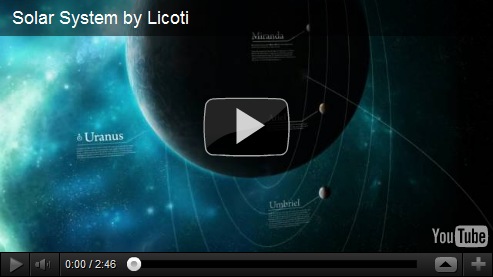
Later, his art was turned into an amazing video by Sylvafilms. Check this out in HD:

I like how certain not-so-famous satellites become the highlight of the picture instead of the major one (e.g. Nereid instead of Triton, and Iapetus instead of Titan.)

The video itself was amazing, with added “video previews” and elevating music. All on all it is a simple and beautiful video and the music almost made me emotional lol (kinda reminds me of the Avatar).

For downloads, check out Licoti’s Deviantart page with download links.

Wednesday, June 1, 2011

Supernova Sonata

Alex Harrison Parker, a PhD in astronomy, and Melissa L. Graham, has created a music – based on a three year observation of four parts of the sky from the Canada-France-Hawaii Telescope – called, the Supernova Sonata.
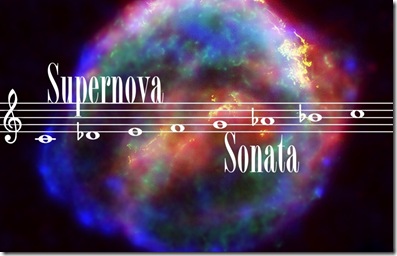
“Cover” of the music. source: APOD

There are many types of supernova, and Alex H.P. chose the type Ia supernova to represent the notes in his piece. Type Ia supernova is a kind of supernova which is created as a result of a lengthy gravitational tug between dying binary stars, one is supersized, one is dwarfed.
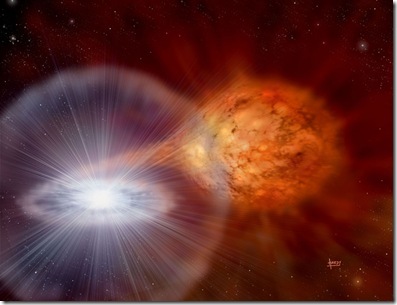
That famous moment when the dwarf star decided to explode as a supernova type Ia. Source: Mars Daily

These supernovas are caught in the four ‘parts’ of the sky determined by the telescope, 241 of them to be exact (between April 2003 and August 2006), which is amazing considering these four parts of the sky are only roughly bigger than the size of a full Moon (as seen in the video below as a comparison).

So to make the music, Alex H.P. decided that:

  1. One second = roughly two weeks of real time
  2. Distance = Amplitude. Distant supernova creates quiet sound, closer one has louder sound.
  3. “Stretch” (a property of how the supernova brightens and fades) = Pitch. Higher stretch values played higher notes. The pitches were drawn from a Phrygian dominant scale.

    The scale chosen by Alex H.P., a scale that is heard mostly in eastern music such as Arabic or Jewish music. Source: Wikipedia

  4. Size of mother galaxy (where the supernova perched on) = Music instrument. Massive galaxies are played with a double bass, smaller galaxies played with a piano.

The result is the Supernova Sonata, a soothing music from a violent death of stars, not different with the Solarbeat.

Source:

Alex H. Parker’s Soundcloud Page 

Alex H. Parker’s homepage

Thursday, October 28, 2010

SolarBeat


SolarBeat is a music making diagram of the solar system.

Each time the planets fully orbit the sun it makes a tone. The site allows you to change the tempo and view the number of time each planet has done a full orbit. Somewhat a representation of the Renaissance 7 musical tones – 7 planets concept.

Check http://www.whitevinyldesign.com/solarbeat/